Intentional selection. Predictable results.
We set out to do just that. Using herd management data shared by cooperating herds, we tracked the performance of cows born in the year 2020 to identify production, mastitis, fertility and health differences across multiple lactations. We focused on Holstein herds that did wide-scale genomic testing and used herd backups through December 2025. Cows were required to have a genomic evaluation to be included in the analysis.
The analysis included data from 50 herds with 125,000 lactation records. Component production metrics required DHI testing so analysis of production totals included 45 herds with 87,500 lactation records.
While individual animals can defy expectations, one thing that became quickly evident in this project, regardless of which trait was analyzed, is that groups of animals ranked by their PTA performed as expected. Animals with higher PTAs for fat and protein achieved higher lactation totals than animals with low PTAs. Animals with higher PTAs for mastitis resistance and lower PTAs for SCS had fewer cases of mastitis and so on. The CDCB genetic evaluations that we rely on to select our A.I. sires and to sort our cows and heifers work!
The main objective of the project was to see if there were performance differences across multiple lactations in animals ranked by Herd Health Profit Dollars® (HHP$®), Net Merit (NM$) and TPI®. Many of the cows in the study continue to be active members of the herd. Where we didn’t have complete lifetime data we used lifetime totals to date.
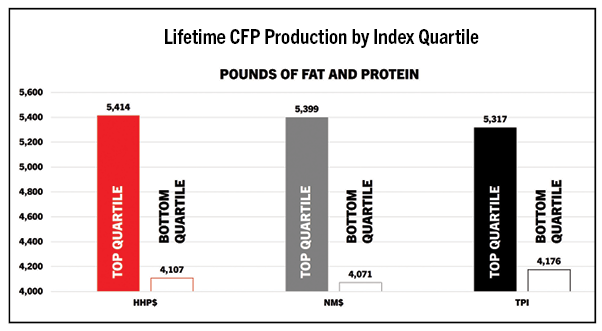
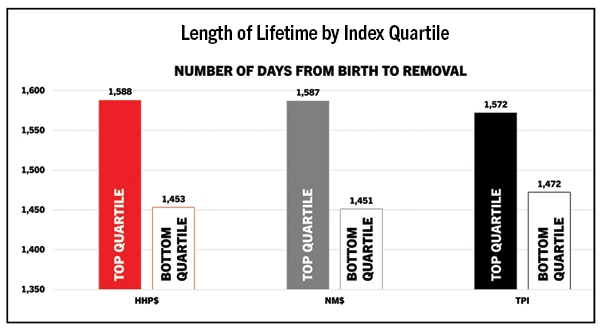
The top-ranking animals for each of the indexes outperformed their herd mates for length of lifetime and lifetime production. Lifetime performance differences for the top quartile animals compared to the bottom quartile were substantial. The top quartile animals for HHP$, NM$ and TPI stayed in the herd at least 100 days longer and produced at least 1,100 more pounds of milk components in their lifetime than their herd mates in the bottom quartile. Animals with top genetic rankings deliver substantially more return regarding phenotype and performance than those with lower genetics.
Understand shifts from lactation to lactation
Cows need to do multiple things well to have successful careers. Physiological and environmental demands change as cows move from first lactation to later lactations. The top performers in first lactation aren’t necessarily the ones with top lifetime performance. This is evident when performance of the top-quartile animals for each of these indexes is tracked across the first three lactations.
The top-quartile NM$ animals had the highest milk component production in first lactation when compared to the top-quartile HHP$ and TPI animals. In second lactation, the component production for the top-quartile animals is very similar for all three indexes. In lactation three, however, there is a slight production advantage for HHP$ compared to NM$ and TPI.
 As cows advance through their careers, this re-ranking of production capabilities is likely due to their genetic merit for fertility and mastitis resistance. Fertility and mastitis are mission-critical for cows to advance to the next lactation. Those cows that breed back efficiently and remain healthy are more likely to get to the next lactation. They are also more likely to have superior performance when they get there.
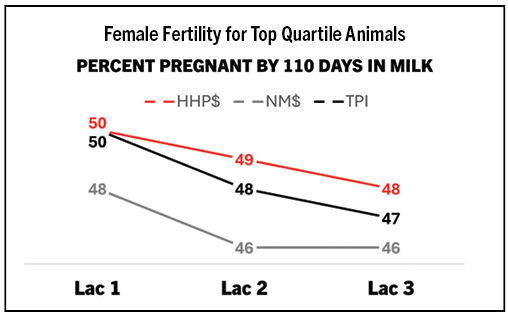
The best HHP$ and TPI cows had similar fertility levels in first lactation and performed slightly better than the high NM$ cows. This shifted slightly in the later lactations as the high HHP$ cows had higher fertility in their second and third lactations than the top cows for TPI and NM$.
For mastitis resistance, the top-quartile cows for each of the indexes had similar incidence levels of mastitis in first lactation. There was reduced incidence of mastitis in the top HHP$ cows in lactations two and three as compared to NM$ and TPI.
 Proactive genetic solutions that help lessen health challenges in older cows
Getting cows pregnant and avoiding mastitis becomes more challenging as cows advance in age. This doesn’t just impact breeding and treatment costs. It impacts production levels as well. It’s important to monitor performance across multiple lactations and not rely solely on first lactation results to judge overall profitability.
It’s important to validate selection indexes and breeding programs using cow performance metrics from current herds. These results show that CDCB genetic evaluations effectively identify trait by trait performance differences. It’s also encouraging to see that the strong mastitis resistance and fertility focus of HHP$ is producing cows that have superior performance in advanced lactations.
TAKE HOME MESSAGE
- Genetic evaluations effectively identify animal performance differences in individual traits.
- All generally available indexes effectively identify top lifetime performers.
- While the top NM$ and TPI animals have a small advantage in component production in first lactation animals over HHP$, the best HHP$ cows yield the same or higher production values in second and higher lactations and yield higher lifetime fat and protein volume.
- The top HHP$ animals have higher fertility, higher mastitis resistance and higher production in third lactation.