During their time in Maine, the group came across a cow that captured their attention. A mating suggestion was made, along with an offer to purchase the resulting calf if it was a bull, and as they say, the rest is history. That cow was none other than Highland Generator O Delores (E-90%) and the resulting bull calf was 7JE177 DUNCAN. One of the most influential sires in the Jersey breed, his daughters possessed a blend of type and performance, finding success both in the showring and on commercial dairies.
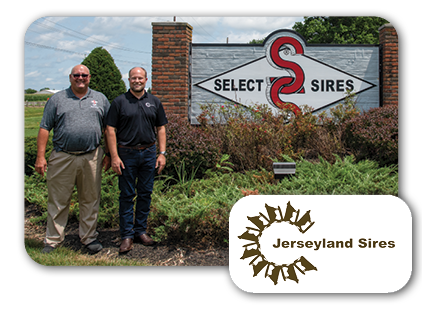
Daughter-proven at Jerseyland Sires and subsequently leased to Select Sires, DUNCAN laid the foundation for the partnership between Jerseyland Sires and Select Sires that began 10 years ago. The two organizations shared a powerful goal of developing and distributing influential Jersey genetics around the world.
Member-owner driven, Jerseyland Sires is comprised of roughly 20 Jersey breeders representing 70,000 cows in herds as small as 100 head and as large as 6,000 head, located in three states. Their smaller size allows the organization to have more direct involvement with their member-owners, taking a boots-on-the-ground approach to better understand the needs and goals of progressive Jersey herds.
Pounds of protein, Productive Life, fertility, longevity and production per stall (due to limited ability to expand) drive the genetic decisions of Jerseyland producers. “Every sire selected to go into stud is reviewed by our sire committee, which is made up of member-owners and dairy managers,” says Tyler Boyd, General Manager of Jerseyland Sires. “We want the people who are working with the cows day-in and day-out making the decisions. The ultimate question we ask them is: ‘Will you use this bull if we put him into stud?’ If our members won’t use the bull, then how can we ask others to use him.”
Focusing on keeping the Jersey breed relevant for commercial dairies today, Protein, CFP, Milk, mastitis resistance and fertility traits have come to the forefront when making mating decisions. Pedigrees also continue to be important in decision making. Sires like 7JE1758 JX THRASHER {6} and 7JE5004 CHROME have had substantial impact on the breed, but their popularity requires outcross genetics to make the next generation of profitable matings. “That’s where this partnership and working with the breeders has really come in clutch,” says Herby Lutz, Select Sires Jersey Development Manager. “There are three or four different, extremely productive genetic lines we can utilize to control inbreeding. Our inbreeding percentage is actually lower than that of the Holstein breed.”
“Every heifer matters,” says Boyd. “With the popularity of beef-on-dairy genetics, it is important that every heifer be profitable and productive. Utilizing sires that are both promising as young sires, but remain productive and profitable after they are daughter proven is critical to allow the breed to continue to grow and prosper.” Stacking proven sires within the pedigrees of young sires creates more confidence and less opportunity for proof variation between sire summaries.
“7JE1789 JX CHATHAM {4} is a great example,” says Lutz. “He didn’t sell a significant number of units as a young sire, but went on to be incredibly popular after he was daughter-proven. JX CHATHAM {4} daughters out of JX THRASHER {6} dams are a fantastic pedigree cross and a cross that really works.”
Future of Jerseyland and the Jersey cow
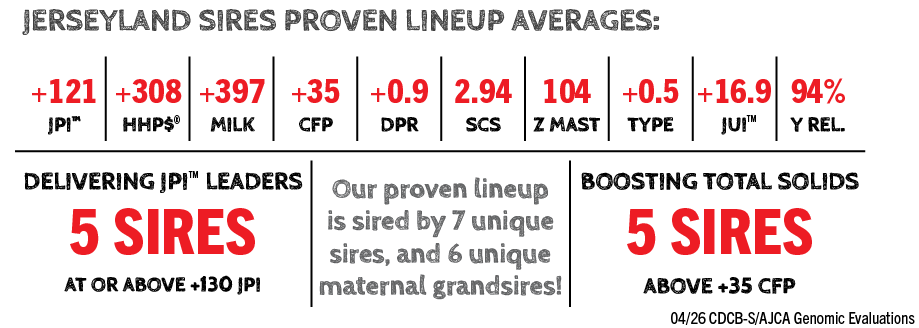
The future of Jerseyland Sires doesn’t look entirely different than its current state – focus on what the breeders and member-owners want. “If you look at our lineup today, you can see the influence of our member-owners. Several years back, our sire committee noted they were having a difficult time getting cows pregnant. We had been driving a focus on Protein for years, and the result of that was losing sight of the more core Jersey traits, including fertility,” says Boyd. “The direction of the sire committee was to pivot and correct. Not only to select sires with better DPR, HCR and CCR, but also to try to find sires that could fix and improve those traits. And that’s how we ended up with JX THRASHER {6}.”
That focus on fertility is being paired with an emphasis on production, to create genetics that both milk well and breed back lactation after lactation, lasting within the herd. “I’m a big believer in dancing with the one that brought you,” says Boyd. “It’s elevating what you have now to the next level. Taking your best cow and making an entire herd modeled after her.”
That model for Jerseyland is formulated on a cow that is right-sized and capacious enough to produce and out-perform her herd mates. A cow with functional type, that is efficient, profitable, long-lived with ample components, who can seamlessly meet the needs of any processor. “Can she get to the barn, and does she have a reason to be there?” asks Boyd. “She has to have a balance of type and production.”
An ideal example of the balance Jerseyland is striving for is 7JE1980 KAMAKAZI. At +1,009 PTAM and +1.3 Type he is siring daughters that thrive in large commercial herds and that can bring home purple ribbons.
“The next step after addressing fertility – we’re making sure not to lose ground there – is determining the correct focus to elevate the upcoming generation of sires to create those really profitable cows that can fit in any kind of a competitive environment,” says Boyd. “Why be good or great at one trait when you can try to be exemplary at as many traits as possible?”