Efforts to reduce methane emissions from dairy farms have largely focused on manure management, including digesters and improved manure storage systems. These investments can play an important mitigation role, but they address only a portion of the
overall emissions picture. Depending on animal housing and manure management practices, manure methane can account for roughly 1% to 35% of a dairy’s total greenhouse gas (GHG) emissions.
The balance comes from familiar areas of the operation: fuel use, feed and other inputs, and the cow herself. Methane produced during rumen fermentation, known as enteric methane, is released as cows convert feed into milk. This area is a focus of
sustainability discussions across the dairy industry.
Reducing enteric methane, however, is not about restricting a cow’s biology. Strategies that interfere with rumen function, cow health or milk production create tradeoffs that don’t pencil out economically. For that reason, many real-world,
effective approaches focus on improving efficiency rather than restricting cows. One of the most practical, and familiar, opportunities is improving cow longevity and reducing the number of replacement heifers needed.
Why longevity matters
Healthier cows that remain productive for more lactations allow farms to optimize culling rates and retain fewer replacements. Producers already recognize the economic advantages of this approach, including reduced youngstock raising costs and increased
flexibility to capture value through beef-on-dairy calves.
What’s less often discussed is how these same decisions affect methane emissions. Replacement heifers require considerable resource investment and produce methane long before they begin lactating. As the number of fresh heifers in a herd increases, more animals are needed overall to sustain the same level of production.
Improving cow longevity changes that dynamic. By helping cows reach their full genetic potential and extending their productive life beyond the current average of 2.3 lactations, farms can significantly improve efficiency. Research shows that cows
achieve their greatest productive potential during their third and fourth lactations. Reaching these later lactations allows a larger proportion of a farm’s fixed and variable inputs such as rearing, housing, and health care to be allocated
toward milk production rather than replacements. Retaining cows also increases the lifetime milk per cow, lowering methane intensity per unit of production.
What the data shows when culling rates change
To better understand how culling decisions influence emissions and efficiency, a series of culling scenarios were evaluated using a representative 1,000-cow Holstein herd. Herd size was held constant, and milk production reflected current industry averages. The purpose of the analysis was not to identify an ‘ideal’ culling rate, but to understand how changes in replacement pressure affect production, efficiency, and emissions across the system (Table 1).
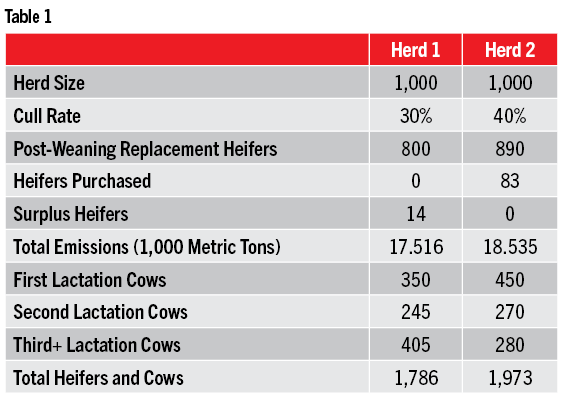
As shown in Table 1, increasing culling rates leads to higher replacement needs, including more heifers raised or purchased, and fewer surplus animals available for sale. At the same time, total milk production declines modestly as the proportion
of first lactation cows in the herd increases.
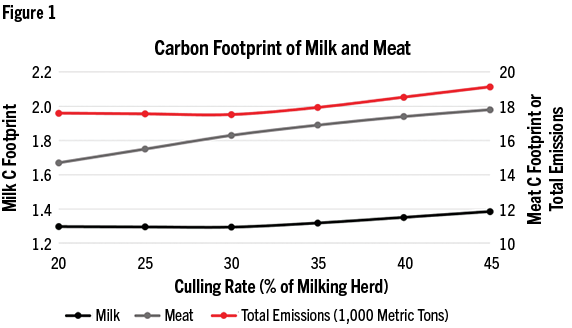
From an emissions standpoint, the results show that moderate changes in culling have little impact on the carbon footprint of milk itself. Emissions per unit of milk remain relatively stable until culling rates exceed approximately 35%.
Higher culling rates require more replacement heifers, increasing the total number of animals in the milking herd. Feed efficiency declines modestly as more resources are directed toward raising replacements rather than producing milk. Total emissions also increase as overall animal days in the herd rise.
Emissions associated with meat production increase substantially in correlation to the number of animals maintained in the herd. Together, these results highlight the close connection between culling decisions, replacement pressure and emissions
intensity.
Don’t let up on your strategy
Managing a herd of more mature cows can present different challenges than managing cows in their first or second lactation including increased incidence of mastitis, lameness, costly days open or other health events. This makes a targeted genetic
strategy essential.
Select Sires’ Herd Health Profit Dollars® (HHP$®) prioritizes the traits that make the greatest impact in addressing these challenges and helps to create cows that continue to be profitable later in life. By helping cows achieve their genetic potential, operations are better positioned to reduce
replacement pressure, enhance their profitability and improve emissions intensity.
Not all strategies to reduce emissions require financial investment for substantial results. Improving cow longevity and optimizing heifer retention is a practical, verifiable approach that aligns long term economic performance with positive environmental
outcomes.