Nutritional Content
Whole milk provides adequate B-complex vitamins, vitamin A, and macrominerals like calcium, phosphorus, magnesium, sodium, potassium, and chloride1,7. However, whole milk is deficient in minerals and vitamins critical for optimal growth and immune function, including iron, manganese, zinc, copper, iodine, cobalt, selenium, vitamin D, and vitamin E, compared to established preweaned calf requirements.
Although starter grains are often fortified with these missing nutrients, intake is minimal in the first weeks of life. Whole milk also lacks commonly recommended additives that support calf health and development.
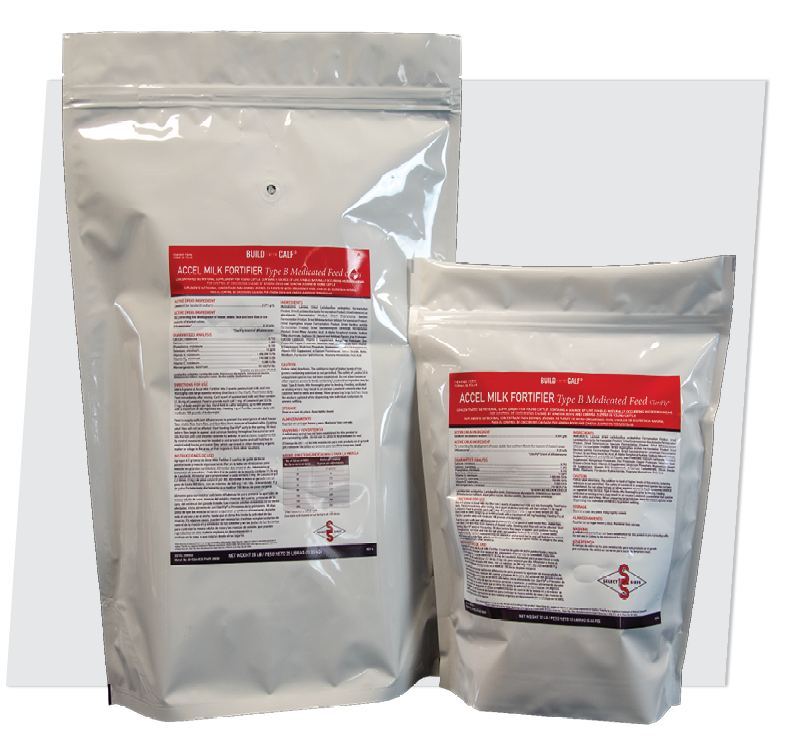
Accel Milk Fortifier from Select Sires Inc. can be added to whole milk to correct these known vitamin and mineral deficiencies.
- Fortifies pasteurized whole milk with essential vitamins and minerals at a low 9-gram inclusion rate per calf per day
- Includes Tri-Mic WD – a probiotic source to improve digestive microflora
- Formulated with yeast cell wall extract (MOS) to support intestinal health
- Medicated with Bovatec® for control of coccidiosis
- ClariFly® larvicide to prevent the development of
house, stable, face and horn flies in the manure of treated calves
Optimizing Milk Components
Typical whole milk contains 25%–28% protein and 28%–30% fat on a dry matter basis, yielding a protein-to-fat ratio below 1.0. Research shows that higher protein levels promote lean tissue growth and skeletal development, while high-fat diets can produce shorter, heavier calves that reach breeding targets later.
A target protein-to-fat ratio above 1.0, ideally around 1.4 (e.g., 24:18), supports intensive nutrition programs. Simply increasing milk volume adds fat without improving the protein balance, which may also suppress starter-grain intake.
Whole milk is roughly 12%–12.5% solids. Many calf raisers add milk replacer powder to increase solids and dry matter intake without increasing feeding volume. For example, adding 17 pounds of milk replacer to 100 gallons of 12% solids whole milk raises solids to 14%, increasing calf dry matter intake from 0.96 lb. per calf per day to 1.12 lb. per calf per day. However, this may not correct an imbalanced protein-to-fat ratio. If the milk test for protein is 3.5% and the fat is 4.2%., the dry matter protein to fat will be 27.8:33.3 (0.83).
Additionally, this approach allows for better management of salable milk, using it efficiently while ensuring calves receive optimal nutrition.

Accel Whole Milk Protein Pivot is a milk replacer powder formulated to adjust the protein-to-fat ratio while increasing solids
of whole milk. With 28% high-quality milk protein and 8% fat, it helps to extend whole milk volume while achieving optimal protein-to-fat balance.
Example:
- Start with 60 gallons of 12% solids milk
- Add 58 pounds of Accel Whole Milk Protein Pivot and 35 gallons of water
- Extend feed to 100 gallons at 14% solids
- Resulting protein-to-fat ratio: 25.3:20.9 (1.2)
Benefits of an optimized protein-to-fat ratio:
- Increased average daily gain and skeletal size
- Improved starter-grain intake
- Enhanced mammary gland development
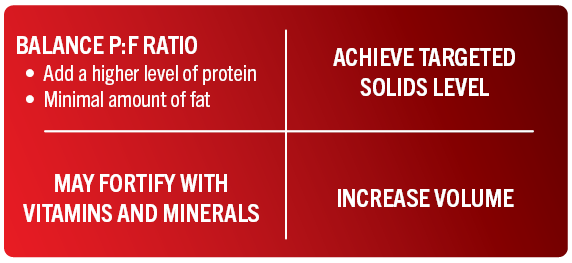
Three important ways milk enhancers can improve a dairy's supply of pasteurized whole milk:
1. Balance
Balancers typically provide a higher level of protein with a minimal amount of fat. They also increase the total solids and overall liquid volume when added to whole milk. When fed at the appropriate rate, balancers act as fortifiers, supplying the necessary
vitamins, minerals, and other additives. When a balancer is used, the protein:fat ratio is improved, the whole milk is fortified and the volume is increased.
2. Fortify
Fortifiers contain additives such as vitamins and minerals to bring whole milk nutrition content in line with National Research Council guidelines. Other options include adding larvacides for fly control, and ionophores for growth promotion and coccidiosis
prevention. When fortifiers are used, the volume of liquid is not markedly increased.

3. Extend
The supply of whole milk can vary considerably and extenders can be used with the primary objective of increasing the liquid milk volume. Extenders, which are commonly complete, non-medicated milk replacers, contribute vitamins and minerals, but the significance
is limited by inclusion rate. When using extenders, there is not a focus on changing total solids or protein:fat rations.

Pasteurized milk enhancers can be used in both individual feeding systems and autofeeders in a group housing setting. They are also highly beneficial in adjusting milk rations to help animals cope with cold and heat stress.
With the improvements provided by pasteurized milk enhancers, feeding a diet of whole milk can truly be the optimal choice for preweaned calf nutrition programs.
References
1 Davis, C. L., and J. K. Drackley. The Development, Nutrition, and Management of the Young Calf. Iowa State University Press, Ames, IA.
2 Heinrichs, A. J., et al. 2003. Journal of Dairy Science. 86:4064-4069.
3 Jones, W. G. et al. 1955. Journal of Dairy Science. 39:188-195.
4 Jorgensen, M. et al. 2005. Proceedings of Managing and Marketing Quality Holstein Steers Conference.
6 National Research Council. 2001. Nutrient Requirements of Dairy Cattle. 7th rev. ed. Natl. Acad. Sci., Washington, DC.
7 Wood, D., et al. 2007. Journal of Dairy Science. 90(Suppl. 1):616. Abstract # 784