THE MODERN JERSEY COW
For decades, the Jersey cow has been recognized for her efficiency and ability to deliver valuable components; however, she represents far more than these traditional attributes. The modern Jersey cow is trouble-free, moderately-sized with an excellent set of feet and legs, high-producing with high components, lasts longer in the herd and is incredibly efficient.
“The Jersey cow can just do more with less,” notes Brent Wickstrom, owner of Wickstrom Jersey Farms Inc. and Chairman of the Jersey Sire Committee. “Other breeds still have a hill to climb when comparing efficiency. Jerseys can make
more milk and produce more components with fewer inputs, giving them a competitive advantage. It’s important for us to maximize the Jersey cow’s ability to be efficient, healthy and long-lasting as we look to create the next generation.”
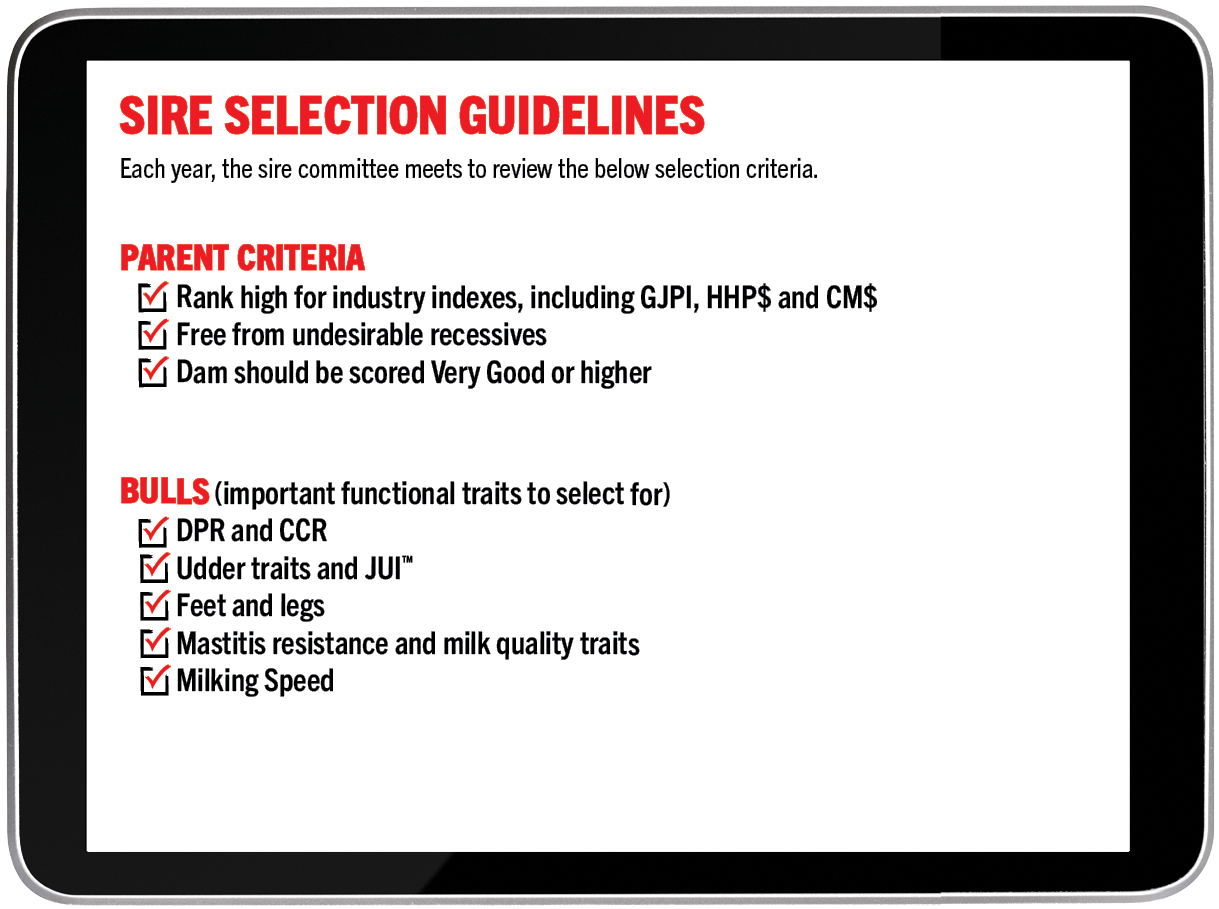
“We have made incredible production gains over the last several years, and while we need to keep our foot on the gas, we need to preserve the fertility advantage producers have come to expect with Jerseys,” says Wickstrom. Travis Lehnertz, owner of TLJ Jerseys, agrees. “Health and fertility traits are some of the hardest drivers for our herd right how. Herd Health Profit Dollars® (HHP$®), Jersey Performance Index™ (JPI™), Daughter Pregnancy Rate (DPR) and Cow Conception Rate (CCR) play a significant role in our breeding decisions.”
As the dairy industry evolves and the value of beef-on-dairy calves increases, so does the importance of high-quality replacement females. “Along with fertility, we need to be emphasizing longevity and livability,” says Wickstrom. “With increased usage of beef semen, we’re making fewer females and need cows to last longer. But we don’t just want old cows for the sake of having old cows. Profitable, trouble-free cows that aren’t popping up with health events are the ones we want making additional lactations.”
Longevity is key for Kevin Souza, Victory Farms, LLC, as well. “If the goal is to reach 95-pounds of energy corrected milk, you have to have cows that last. A herd made up of 40-50% first lactation cows isn’t going to get you to where you want to be.”
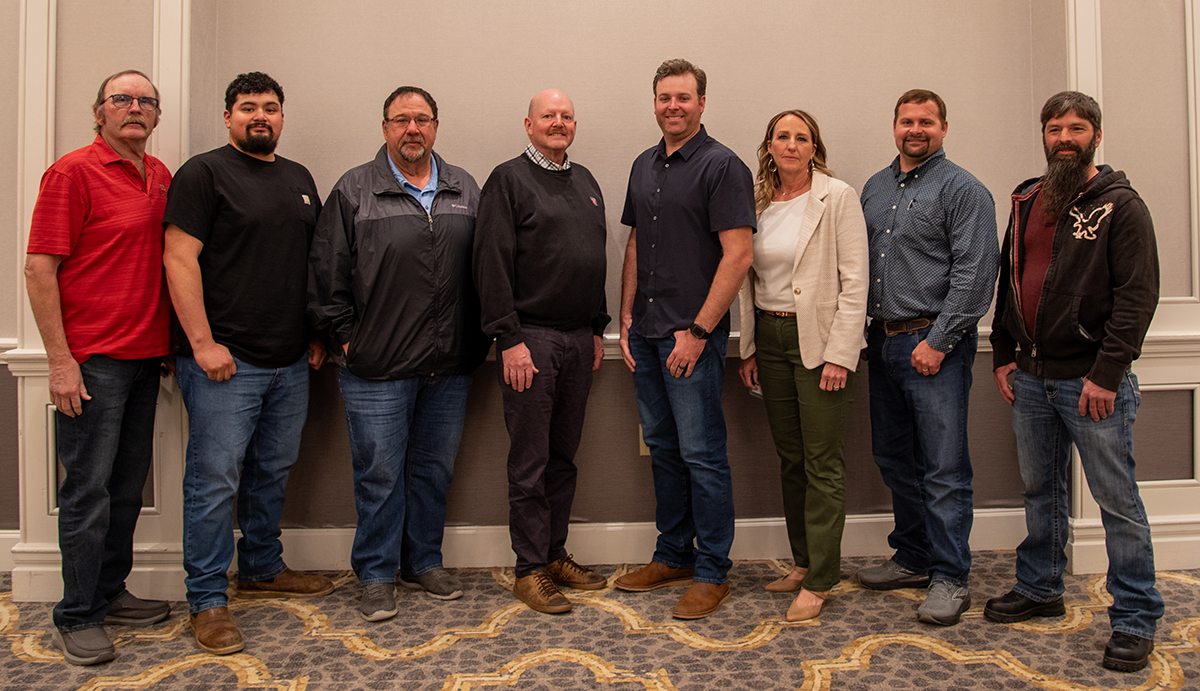 Sire committee members l-r: Larry Voigts, Amazing Grace Dairy, Wilton, WI; Kevin Castillo, Forest Glen Jerseys, Dayton, OR; Kevin Souza, Victory Farms, LLC, Revillo, SD; Matt Lippert, Grass Ridge Farm, Pittsville, WI; Brent Wickstrom, Wickstrom Jersey Farm Inc., Hilmar, CA; Sheila Sherwood, Cedar Ridge Farms, Nephi, UT; Walter Graves, Clover Farms, Olney, IL; and Travis Lehnertz, TLJ Jerseys, Plainview, MN
THE NEXT GENERATION OF SIRES
The American Jersey Cattle Association recommends that Jersey breeders should make 50% of the dairy matings in their herd to proven sires and 50% to young genomic sires. “Producers get very excited about high genomic young sires and sometimes hyper-focus on one or two sires within their breeding programs,” notes Herby Lutz, Jersey Development Manager, Select Sires Inc. “Losing track of the diversity of sires utilized within a breeding program limits growth and variation within the population.”
“Our goal is to have balance within our breeding program,” notes Wickstrom. “We don’t intend to be extreme with any one sire.”
“Elite genomic young sires will always be appealing,” says Lehnertz. “A breeder has to use young sires to capture the latest available superior genetics, it only makes sense if you want to advance your herd as quickly and efficiently as possible. However, by diversifying the sires utilized, it gives a breeder options. If one of those sires doesn’t turn out as well as I’d hoped, I haven’t used him exclusively and set my herd back. If a young sire really hits and comes through with a phenomenal proof, I can go back and continue to utilize his genetics within our herd as a proven sire.”
Fostering diversity and creating the next generation of elite sires are pillars of Select Sires’ Jersey sire program. Partner herds play a key role in creating, developing, and early testing Select Sires’ upcoming Jersey sires. “The partner herds have really been a success story,” says Lehnertz. “They provide an opportunity to create sires and genetic lines that otherwise wouldn’t be an option. Jersey genetics made by Jersey breeders means a lot.”
“Jersey partner herds really do create an opportunity for more diverse genetics and a chance to develop sires faster,” notes Souza. “By having early access to sires and utilizing an intense IVF program, we can develop and get a better sampling of daughters more rapidly. We can see the data in real-time.”
“7JE1789 JX CHATHAM {4} is a prime example of being ‘discovered’ in a partner herd,” says Brad Barham, Regional Marketing Manager for Premier Select Sires. “We saw those first daughters at Clover Farms and knew we had something special.”
"The board of directors relies on this committee to provide direction and input on the sires we are going to develop. It's a blending of the sciences, combined with what the breeders are seeing and what the data tells us to create," says Herby Lutz, Jersey Development Manager.