Inventory management is revenue management
A key part to any herd inventory projection is expected calvings. Easy enough when we were only creating replacements, but when we throw beef into the mix, the service breed used may affect the uniformity of the flow of fresh animals. Dairy systems are traditionally set up for an average gestation length of about 280 days (Holstein 279 days and Jersey 283 days) while beef breeds tend to be more extended. External data shows Angus has the most similar gestation length to Holsteins and Jerseys at 283 days, while Simmental and Charolais are 289 and 290 days, respectively. Accurately managing expected calving dates will aid in planning for future replacements and movement of cattle.
Impacts of gestation length variation
Varying gestation lengths can also increase the likelihood of metabolic diseases following transition because of potential overstocking in the close-up pen. Knowing and managing the differing gestation lengths is integral in supporting proper stocking
densities in the far-off and close-up pens. Optimum stocking density of far-off pens should not exceed 100% and close-up pens should not exceed 80%. In a recent study1, each percentage point increase in stocking density during the period
of 8-2 days prior to calving resulted in an increase in disease risk. Multiparous cows were particularly affected. It was found that for each 1% increase in stocking during this period resulted in a 12% increase in disease risk and a milk reduction
of 0.44 pounds per day at 28 DIM. Days open and risk of culling were also increased in all cows.
How do we become more precise in our management of these potential challenges?
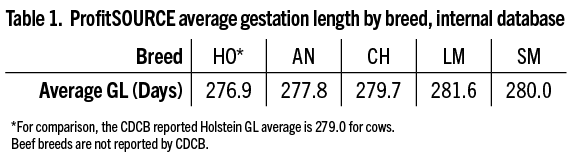
For management reasons just like this, Select Sires’ ProfitSOURCE® beef on dairy program is driven by data. On-farm ProfitSOURCE-specific data from across the country allows us to get a closer look at how the Select Sires lineup performs, fueling the ability to fine tune practices. Internal data shows a more favorable gestation length outcome, with each breed’s average much closer to the Holstein average (Table 1) with a max average difference of +6 days to the larger population’s potential +11-day difference.
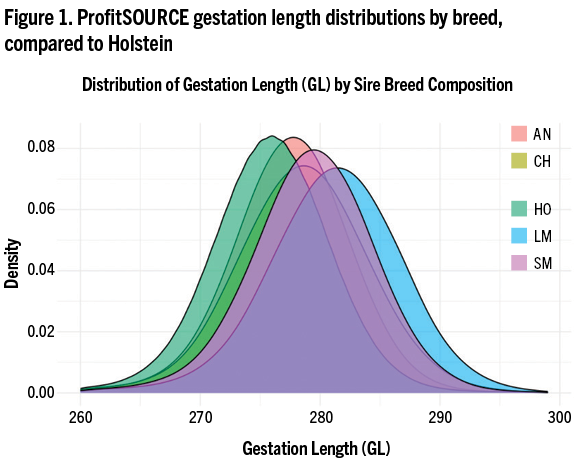
Of the breeds, the ProfitSOURCE Angus lineup’s gestation length (GL) distribution remains the closest to the Holstein breed as expected, clocking in at a respectable 278 as visualized in Figure 1. This makes sense, as birth weight and gestation length are correlated, so the two traits tend to move together in the same direction. Since GL itself is not an exact predictor or guarantee of calving ease or birth weight, we continue to ensure the ProfitSOURCE lineup is selected for calving ease with an avoidance of excessively high birth weight.
What’s next on the horizon for ProfitSOURCE?
Select Sires will continue to improve the lineup knowing that individual sires can see a few days’ difference from one another on expected gestation length. Tailoring the right sire profile to sensitive management systems, like grazing or seasonal operations with a need for tight calving windows, will further drive profit.
Bottom Line: Most dairies create pen sizes for the average. Using genetic strategy and inventory management calculators enhances plans for a consistent number of replacements moving throughout the dairy system, while allowing producers
to take advantage of high beef calf prices and optimize their ProfitSOURCE usage – without disrupting transition periods. Accurately managing dry cows and their movement into far-off and close-up groups will reduce transition disease and
maximize a cow’s lactation, and the data-driven insights that come with ProfitSOURCE will only bring more refinement to these profit-crucial strategies.
References:1Cook, J. G., Pepler, P. T., Viora, L., & Hill, D. L. (2024). Assessing transition cow management in dairy cows for improved health, milk production, pregnancy, and culling outcomes. Journal of Dairy Science, 107(12), 11381–11397.
https://doi.org/10.3168/jds.2024-25047