The CDCB has elected to report PTA for milking speed on a pounds of milk produced per minute basis, with an average of 7. By expressing milking speed in pounds / minute, we avoid rewarding poor milk yield as cows producing little milk naturally spend less time being milked. The PTA for most bulls ranges between 6.5 and 7.5, which, for a cow milking 100 pounds per day, equates to a 1-minute difference per milking.
Protect udder health
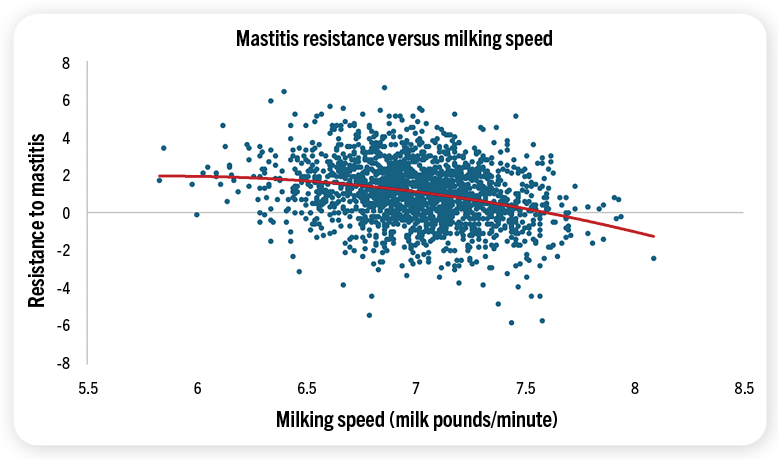
It has long been established that a fast milking speed is unfavorably associated with udder health. You can see the relationship between milking speed and mastitis in Figure 1 that shows PTA for CDCB Mastitis Resistance versus PTA for Milking Speed (MSPD). There are around 2,000 bulls represented in the chart, born in 2018 or later, and with at least 70% reliability for MSPD. The correlation between milking speed and mastitis resistance for this population of bulls is -0.27. As expected, the correlation between milking speed and Somatic Cell Score (+0.39 SCS) is also unfavorable. You will note that the relationship may not be entirely linear, with extremely high values tending to be the most problematic.
The relationship between speed and mastitis has little to do with milk yield. In some countries, farmers report on whether cows leak milk and the genetic correlation between milk leakage and milking speed is both strong and unfavorable. Cows that milk out rapidly tend to have a weaker sphincter, which is the muscle that opens and closes the teat end; as you can imagine, a weaker sphincter muscle is associated with a reduced ability to keep bacteria out of the teat end.
Milking speed does have economic value as longer milking time increases labor, electricity, and equipment wear. However, it is not included in selection indexes like CM$ or Herd Health Profit Dollars® (HHP$®) at this time because it is a new trait. Deriving an economic value for milking speed is also complicated by udder health considerations and the fact that, in a parlor milking system, the average cow’s milking speed is not as important as the milking speed of the slowest cow. My recommendation is that farmers, rather than trying to increase milking speed for their average cow, use this as a tool to avoid sires with slow milking daughters.