Slick Isn't a Novel Trait, it's Reproductive Efficiency
News and Updates
4/24/2026
Heat stress is one of the most expensive, persistent, and biologically limiting challenges in modern dairy production. Exceptional management, emerging technologies, and advances in genomic testing and research have accelerated dairy efficiency at an extraordinary pace over the past two decades. The progress has been remarkable, prompting dairies to examine every facet of their operations and cattle with a more critical, strategic lens. Once thought of as a trait limited to herds near the equator, slick is now being rediscovered as a powerful genetic tool that has been hiding in plain sight.
Far from being a novelty, slick is a proven reproductive efficiency trait with decades of scientific backing, most notably from the University of Florida, and growing commercial relevance in the U.S. and around the world.
To understand why slick matters, it helps to look at the environmental reality dairy cows face in major U.S. dairy states.
Heat is a daily norm in key dairy regions
Below is a snapshot of typical July temperatures in three major dairy states, based on long term climate averages:
- Arizona: Average July temperatures reach 95.2°F
- California: Average July temperatures reach 90.9°F
- Texas: Average July temperatures reach 91.9°F
These aren’t occasional heat waves; they’re the baseline. They create a physiological environment where cows must constantly work to maintain core body temperature, therefore sacrificing feed intake, milk production, and most critically,
fertility.
When heat is relentless, genetics that improve thermoregulation can be game-changing.
Why slick works: the science behind the gene
Research from the University of Florida has repeatedly demonstrated that cattle with a slick hair coat maintain:
- Lower core body temperatures
- Higher sweating rates
- Improved feed intake during heat stress
- Better conception rates in hot climates
By measuring vaginal temperatures in cows living in a freestall environment, researchers found cows with a slick hair coat averaged 1.1 degrees Fahrenheit lower body temperatures at the hottest times of the day (noon to 3 p.m.) compared to the
non-slick hair coat cows. They also found that slick cows that calved during hot months (May to July) produced nearly 10 pounds of milk per day more during their first 60 to 90 days in milk than non-slick cows.
Additional studies have also shown that heat stress, particularly during late gestation, leads to significant long-term impacts on offspring. Slick not only helps the current herd tolerate the impacts of heat stress more efficiently, but it protects the next generation as well.
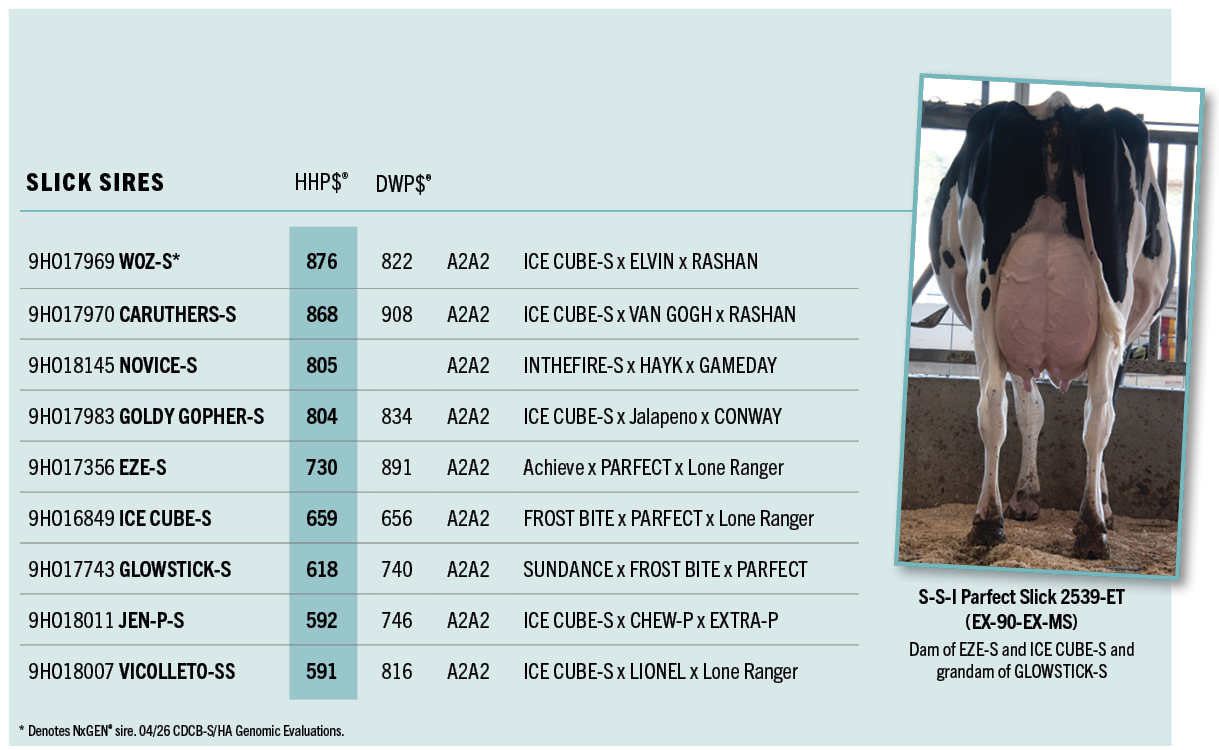
Global value: Slick genetics beyond the U.S.
While U.S. herds are just beginning to adopt slick more widely, the trait has long been valued in Central America and South America where heat and humidity are extreme.
In these regions, slick cattle consistently outperform non-slick cattle in pregnancy rate, days open, and overall resilience. The global message is clear: slick is a fertility trait expressed through heat tolerance.
Slick at Select Sires: A lineup built for reproductive efficiency
Select Sires has become a leader in bringing slick genetics into mainstream U.S. dairy breeding. Slick hair coat sires are selected not only for heat tolerance but also for production, type, and health traits that match modern, long-term herd goals.
“We have seen vast improvements in production, health and fitness traits,” says Mark Kerndt, Aggressive
Reproductive Technologies™ (ART™) Program Manager, Select Sires Inc. “We are breeding the horns out of the breed and are now also focusing on making the Holstein breed more heat tolerant, through the gradual introduction of the
dominant slick allele into our cattle. The ART program has been fortunate to have some early success in slick genetics and we look to continue our leadership position in 2026. We expect several hundred potential slick calves to be born in our
program in 2026 and the parent averages on these matings are very close to our non-slick matings. As many of our targeted slick markets can also be grazing markets, we have tried to combine those genetics while also focusing on adding this heat
tolerance trait to the overall Holstein population and to all of our markets.”
Select Sires is now in the fifth generation of slick calves born from the organization’s matings. All of Select Sires’ slick calves have been born in Wisconsin and adapt to cold weather as needed. Kerndt says, “They do grow hair!
Most people think slick advantage is only short hair, but research shows it is more than that.”
“Heat tolerance is a valuable economic trait,” says Kerndt. “By adding the slick trait to the elite genetic package offered by Select Sires, we can accomplish our goal of helping dairies everywhere become more profitable.”
Slick isn’t novel, it’s necessary
Cattle with slick hair coats aren’t a fad or a curiosity. It’s a biologically validated, globally proven reproductive efficiency tool that aligns perfectly with the environmental realities of modern dairy production. As summers intensify
and herds push for higher fertility under heat stress, slick genetics offer a simple, heritable, and powerful solution.
And with Select Sires leading the charge in high-quality slick hair coat sires, the industry now has access to genetics that combine heat tolerance with the production and type traits U.S. dairies demand.