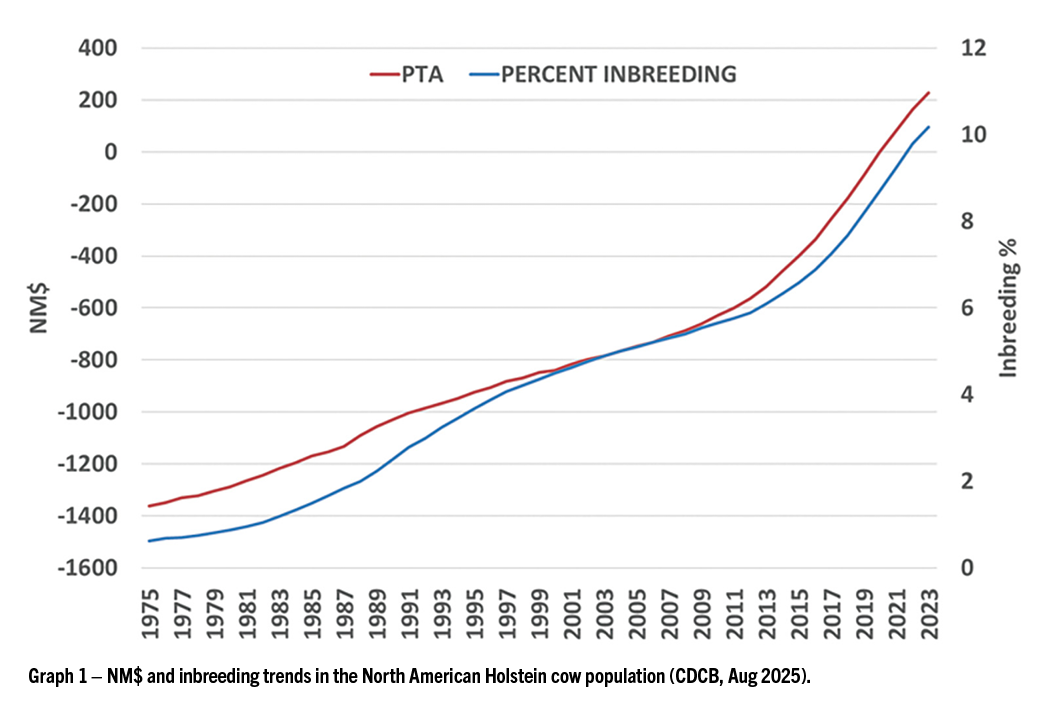
Can such a trend continue for the foreseeable future?
To answer this question, we look at two aspects of inbreeding: increased probability of expressing recessive deleterious or lethal alleles, and the loss of genetic diversity.
Inbreeding, which results from the mating of close relatives, increases the probability of expressing recessive deleterious alleles. This has a direct impact on animal fitness. However, because the population is under intense selection, progeny with such weaknesses are likely culled. This means there is partial selection against alleles with detrimental effects as soon as they are expressed.
Despite this known impact on fitness, in most dairy herds, we have not yet observed reduction in production or significant reduction in fitness due to inbreeding. This is likely due to simultaneous improvements in management capabilities. Management practices are an often-overlooked factor in discussions about the impact of inbreeding on animal fitness. As inbreeding levels accumulate due to genetic improvement, we expect more susceptibility to environmental stressors, such as heat. Improved management practices, over the past decades, may help shield animals from stressful environments and therefore, we do not observe the expected reduction in fitness due to increased inbreeding.
Perhaps the most important negative effect of inbreeding is the loss of genetic diversity. This is critical for three reasons. First, the amount of genetic diversity directly determines the potential for future genetic progress. Second, populations with reduced diversity are less adaptable. They are more vulnerable to changing environmental factors and new pathogens. Finally, any loss of diversity requires a long time to naturally recover that genetic diversity.
Reduced diversity due to increased homozygosity also manifests itself in reduced fitness. It is interesting to note that reduction in fitness is happening at a much slower rate compared to the rate of genetic progress mostly because of continued improvement in environmental management. This could tell us that the level of genetic diversity is not yet too low.
Take home message: The dynamics of genetic diversity and inbreeding are complex. While we know increased inbreeding levels and the consequent decline in genetic diversity are detrimental to population fitness, we have not yet observed any reduction in production or any significant reduction in cow health/wellbeing. On the other hand, improved herd management practices may be masking inbreeding depression. According to Graph 1, there is no slowdown in the rate of genetic progress. This suggests there is enough genetic diversity in the population, and the genetic trend is not yet close to plateauing. Even though current losses due to inbreeding do not appear to be severe, active inbreeding management through the use of diverse sire lines and mating programs is essential for sustainable genetic progress, maintaining animal fitness and safeguarding against accumulation of deleterious alleles. Rest assured, Select Sires is doing everything possible to create genetic diversity in our sire development programs for your benefit over generations yet to come.